Index 1 - 2 - 3 - 4- 5 - 6 - 7 - 8 - 9 - 10 - 11 - 12 - 13 - 14 - 15 - 16 - 17 -- --
4 - Broadcities
I propose small, autonomous, re-balanced and self-sufficient Broadcities, that will harvest crops and produce meat, exploiting and protecting sustainable forests, and will sustain small clean industries. These cities will create minimum energy using not only solar and wind power, but water and gravity. Oil will be used for trains, planes and inter-urban cars. Pollution by travelling and transport can be reduced to the minimum if we mostly use bikes and public transport. Industrial goods produced abroad will cross the world on wind powered trans-oceanic cargo boats: sailing ships will be back. On land, newly designed steam trains and light electric trains will be developed, and small lorries for inner-city transportation. Today, 55% of all electricity produced in the planet is lost in high voltage transmitting lines. In Broadcity, house and building will produce its own low voltage power, 9V or 12V. By doing this in Broadcity, we will reduce electricity needs about 80%.
Broadcities will re-instate safe known analog technologies for educating children: it is proved that blackboard and chalk stimulates children's attention and creativity by co-ordination of mind, arms and hands, inter-acting with other students in a real room; digital communication can be harmful. We will stimulate proved technologies that promote the arts, observing, printing, building in harmony with Nature. This means a functional return, rather than organisational, to "Burgus" (commercial cities) from the early Renaissance, where empirical decisions enriched all classes and where freedom and law were the path, without frantic consumerism.
Broadcities are "communi" ("communitas" in Latin: to share a space), independent organisms living together (in a biological sense), and "common", a piece of open space for public (in Roman and British law sense). People will agree to protect nature and exploit it rationally. I propose a combination of industrial patterns with limited electronic technology, basically not applied into Habitat or mobility unless absolutely necessary, but indeed in scientific and industrial research applications, like medicine or space research. In day-to-day living, our extensions (in the anthropological sense, machines, tools, devices) must be mostly analog, affordable, recyclable... and reasonable slow: we only need speed for space exploration... and for our thoughts. There is no doubt the world is about to split in two: the Cybers and the Earthlings. Whose side are you on?
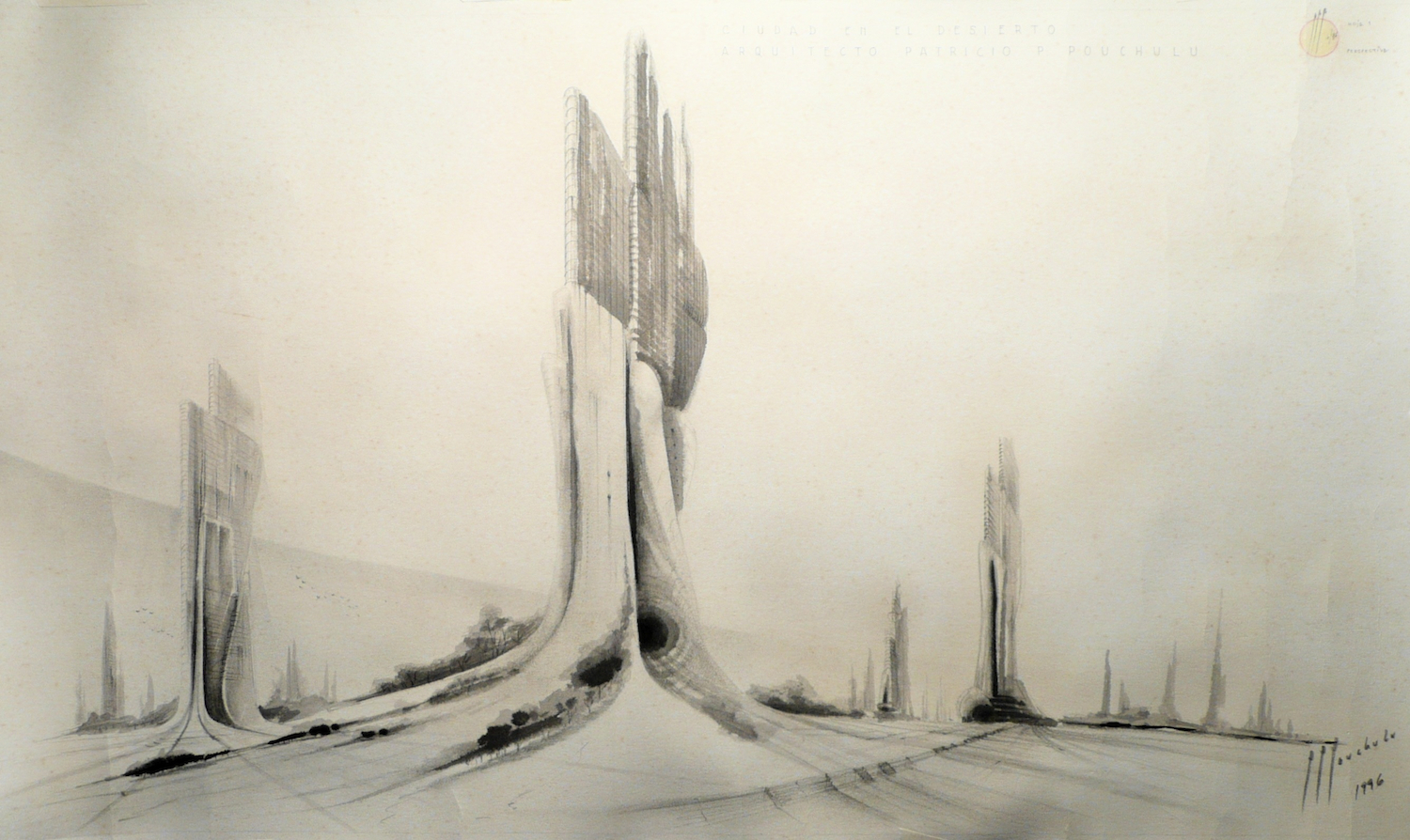
Proyecto de Ciudad en el Desierto / Project for a City in the Desert, Patagonia, Argentina, 1996. Original drawing by Pouchulu. Pencil, gouache and black ink on aquarelle Canson.
The picture above is Pouchulu's Proyecto de Ciudad en el Desierto / Project for a City in the Desert, Patagonia, Argentina, from 1996. A series of scattered inhabited towers, which resist the fierce winds from Antarctic, are connected underground. The basements include commercial, educational and sport facilities, semi-underground intensive agriculture and water reservoirs at the top. The structures, erected in an area a few hundred metres high, seem to be waiting for a storm...
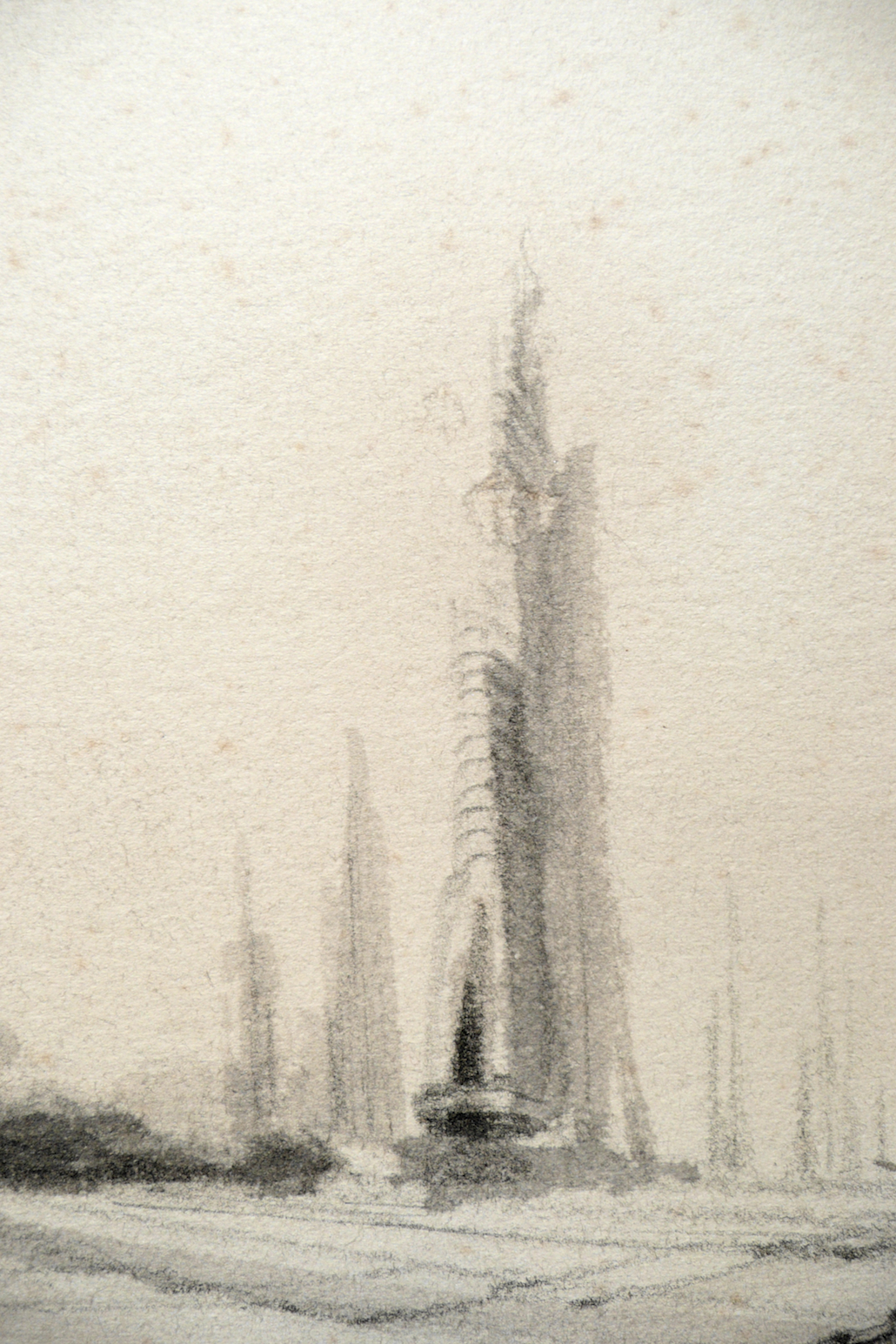
Idem, detail of North-East factory, water reservoir and wind power towers.
This architectonical exploration intends to question till which point we are directing our research in the right perspective.
Regarding the scary sea level rise warning theory, nothing extraordinary has happened: the sea level is both rising and descending. It has been doing that for millions of years. It is also useless to set an "average" sea level. It is unclear if Greenland and the Antarctic ice will start melting, totally or partially; it is also uncertain where the sea will rise and if it will at all, and where will recede and where will move inland: it has been noticed recently that the oceans are so heavy that they influence Earth's rotation balance, its distribution responds to an extremely complex mathematical model, which is still under study. We known for some time now that the Earth is not a perfect sphere but a slightly "pear shape" object, wider in the Southern Hemisphere. Satellite measurements, for this particular issue, proved imprecise, because the complexity of fixing a non-regular geometrical pattern reference (the Earth as a sphere) is forcing to use unorthodox mapping methods in a very dynamic model: the sea rises and lowers every day because of the link between Earth and Moon's gravity and Earth's rotation. Artificial satellite's orbits are assumed regular, but they are not; we managed to control them by a real time self-adjustment data, controlled by its height respect the surface of the Earth, "whatever" profile our sphere has. This imperfection forces mathematicians to try odd calculus and is all still in progress. Three dimensional references workwell for rockets and sattelites; GPS does work for vehicles with half a meter error, but these margins are unnaceptable for land and ocean mapping, because, in fine carthography, the accumulation of error margins' assumptions ends up as useless data. The discipline of comparative geologic and geographic meassurments is a challenging job. Sea level can only be meassured on ports with phisical devices, and considering seasonal tides and daily, changing winds; there are only about 40 reliable stations all over the world. Data collected by GNSS (Global Navigation Satellite Systems), using reflectometry, this is, measurements from reflections from Earth's navigation signals like GPS) is complementary, and natural indicators like coral reefs must be taken with care because micro local disturbances of sea level, because of seasonal and arbitrary wind factors, normally altering values registered.
The weight of the continents (Crest, in geological terms) is linked with the ocean's weight. The up and down sea level evolution in geolocial history could explain why there are ancient cities buried underwater at more than ten or even twenty metres deep, in places in the middle East, Greece, Mediterranean, and parts of Asia: not just as a consequence of Earth tremors or soil accumulation, but also because the sea level has been changing during ice ages (particularly noticed in the last one, 10 thousands years ago¹), because once the poles' excessive ice was gone, sea level was distributed differently in order to re-balance the weight lost on the poles, according to complex geological and mechanisms present in our planet which are not fully understood. To assess the melting of glaciers and poles, it is logical to accept it has been produced by solar cycles during million of years.
Architects have the obligation to alert in one way or another about Habitat Change, when it applies. Floods experienced in several regions in all continents in the last years can be explained because of severe, recurring storms (they happened before many times and have been recorded, but media and unexperienced technicians ignore it), not because of temperature "anomalies" as stated in the news; these storms, generally close to the coast, are tropical events that happen even in template and colder areas, not only in summer but in autumn and spring. The possibility recording in digital media and mobile phones is giving the world the impression that there are more storms, rain and floods. I doubt it. On the contrary, there are more people living in dangerous places, cities and suburbs extended into lower areas, close to rivers and seashores. People tend to settle around rivers. And there are 8 billions more people comparaed with a century ago. Floods are not a consequence of abnormal rain, but to the fact that people are setting in the wrong place. Rather than escaping from river floods, it will be better to learn from it and live with it, particularly if in some cases these floods are ocassional and not permanent. In flat regions, floating docks could be a simple solution.
If the challenge is to build communities in hot deserts, there is a relatively simple solution: avoid high-tech tecnology. Ancient cultures like the Bereber or the "Arabs" lived in extreme environments. The almost forgotten Master Louis Khan knew and taught about this. We could even try partial underground communities. Indeed, to excavate is expensive; some countries like Switzerland, Germany, the US and Russia have extensive experience in underground constructions: they built large bunkers underground, millions of square metres during World War II and later in the Cold War, even today. There are indications that they still do, for many reasons, not only a possible nuclear war, but probably anticipating an unlikely space clashing event, like a celestial body. In Russia, nearly 70% of its population is ready to escape to refuges in case of war or meteorite. In the US only preppers are taking this issue seriously, apart from the government and billionares that silently -more than secretly- invest billions of dollars every year to maintain and expand underground infrastructures. They expect only a selected group of leaders and service groups will move there, if necessary. Our topic, however, does not deal with those extreme situations but with a democratic long-term scenario. How to create good, humanistic and quality living conditions in a changing environment that is not necesarily climate, but Habitat Loss. Any industrial city and Metropolis from the 19th and 20th centuries has been exposed to this loss, pollution was (and is) just a sign of something more complex. We do not know how to integrate harmonically with with Mother Nature.
Compared with the complexities of building underground, some sort of dome can be an option. Without the need of creating some type of environement visualised in the great movie Logan's Run (1976), directed by Michael Anderson (adapted from an excellent novel by William F. Nolan and George Clayton Johnson) , the main challenge is growing vegetables, fruits and producing meat, in a limited indoors area. What is known as a Circular Economy system (recycling everything following a closed loop) should be rename it Spiral Wconomy, because there is nothing circular, nothing gets back to the same point neither in time nor space. At the moment the technical limitations are high, particularly for large number of occupants. We produce too much waste, we need and breath too much pure air. NASA is working on this for the Mars project. More than half a centruy has passed since Neil Armstrong and Michael Collins walked on the moon -as a child I remember watching them in our black and white TV set, back in July 1969... two months later I was waving to them in Buenos Aires- and with all possible effort they managed to stand there a few hours. NASA and the military know more than we do about survival. But they know nothing about architecture and cities, we do.
Back here on Earth, a dome for up to fifty people can be solved with a relatively simple structure. There are structures built in Antarctic, but with materials brought from land. Another challenge is to imagine a series of domes for a thousand people or more, spetially if the space is fully treated with architecture qualities. Not just structurally, but a whole service management is needed. Under extreme conditions, and from a functional point of view, a series of routines, tasks, strictly hierarchy organised will dictate people's life; no much space for free time; only professional bodies like the marines can handle such tasks in effective ways. There are hours, days or even weeks where it will not be possible to leave the dome. One basic clue for sustainability: to use and process local materials.
If we have to inhabitat a new environmental region like under the sea, we need sophisticated technology: I remember the Precontinent experiment by the incredible Jacques Cousteau; they requiered very creative solutions and resources, in many ways paralell of that applied in outer space, where there is no oxigen, and complex air-pressure issues.
Our Broadcity is a new settlement in between urban and suburban, a reasonable small town gently expanded outwards, where some of the issues and subjects proposed in my Habitat Change book are developed (this website is a synthesis), combining living, working and leisure with farms and small industries, all linked with clean mobility. The programmatic elements will be combined and integrated in an organic approach. Each Broadcity should have between 500 and 1.000 inhabitants.
Programme
1- Forests, farms and livestock breeding.The "Six of One" Commands in Broadcity
1- No pavements or asphalt, but gravel paths, and railways. Nature will be King.
2- Each house or building will generate its own LV power.
3- The city will be structured around organic, flexible geometry, respecting geological conditions.
4- Forests and green areas will be integrated and follow patterns.
5- Like in a Mediterranean (Roman, Latin) city, Public and Private areas will not be differentiated, but related.
6- Space superimposition (same programme items) and layout flexibility (mobility, leisure) will link the different parts.
¹ The Pleistocene epoch lasted from 1,650,000 to 10,000 years ago. It had great fluctuations in temperature that caused the Ice Ages, with glacial periods followed by warmer interglacial periods. Several extinct forms of human, forerunners of modern humans belong to this time.
Go to the next chapter, here.
1 - 2 - 3 - 4- 5 - 6 - 7 - 8 - 9 - 10 - 11 - 12 - 13 - 14 - 15 - 16 - 17 -- --
Contact Pouchulu here, or send an email to: architect@pouchulu.com For more information in Deutsch, English, Español and Français, go here.
Background photo: planet Mars, dust storm, PIA15959, Mars Reconnaissance Orbiter (MRO), courtesy of NASA
up