Index 1 - 2 - 3 - 4- 5 - 6 - 7 - 8 - 9 - 10 - 11 - 12 - 13 - 14 - 15 - 16 - 17
Earth's Habitat Change
Pouchulu architect
1 - Introduction
"Lo! Death has reared himself a throne
In a strange city lying alone
Far down within the dim West,
Where the good and the bad and the worst and the best
Have gone to their eternal rest.
There shrines and palaces and towers
(Time-eaten towers that tremble not!)
Resemble nothing that is ours.
Around, by lifting winds forgot,
Resignedly beneath the sky
The melancholy waters lie.
No rays from the holy heaven come down
On the long night-time of that town;
But light from out the lurid sea
Streams up the turrets silently —
Gleams up the pinnacles far and free —
Up domes — up spires — up kingly halls —
Up fanes — up Babylon-like walls —
Up shadowy long-forgotten bowers
Of sculptured ivy and stone flowers —
Up many and many a marvelous shrine
Whose wreathéd friezes intertwine
The viol, the violet, and the vine.
So blend the turrets and shadows there
That all seem pendulous in the air,
While from a proud tower in the town
Death looks gigantically down.
There open fanes and gaping graves
Yawn level with the luminous waves;
But not the riches there that lie
In each idol's diamond eye —
Not the gaily-jeweled dead
Tempt the waters from their bed;
For no ripples curl, alas!
Along that wilderness of glass —
No swellings tell that winds may be
Upon some far-off happier sea —
No heavings hint that winds have been
On seas less hideously serene.
But lo, a stir is in the air!
The wave — there is a movement there!
As if the towers had thrust aside,
In slightly sinking, the dull tide —
As if their tops had feebly given
A void within the filmy Heaven.
The waves have now a redder glow —
The hours are breathing faint and low —
And when, amid no earthly moans,
Down, down that town shall settle hence,
Hell, rising from a thousand thrones,
Shall do it reverence."
City in the Sea,
Edgar Allan Poe, 1845.
The Earth has been affected by 10.000 years of constant deforestation and 200 years of intensive pollution. 19th century science developed into 20th century technique, producing a self-destroying scenario where architects (which for centuries created beautiful universes) are not leading in the environment anymore. We have been replaced by technocrats and engineers, who ignore the nature of things. For decades, theoretical discussions show a detachment from Habitat. Architects became fashion designers, often in giant urban proportions, building anti-sustainable contraptions in the name of sustainability. Glass towers in deserts like Dubai are seen as a success and promoted in magazines, wasting energy and resources. Marshall McLuhan anticipated that the speed of electronic information was catapulting perception, conscience and knowledge, while Jacques-Yves Cousteau alerted about the agony of the sea. Virtual reality is deactivating children's reading, writing and interpreting capabilities (which are non-biological). Search engines annihilate students' association and logical analysis capacities. Social networks kidnapp their mind. Our conscience understands what we see on screen as real, when we actually process mirrored images. For your subconscious, however, what you see in the Internet (as this) is unreliable, because it is unreal: there is no paper, no materiality, things you will never touch. Somehow we got trapped in between, we are confined in mimic information. Data collected in several published scientific researches indicate that most vertebrate and invertebrate species would approach mass extinction within decades. There are 8 million life forms on Earth: according to some sources, 100 to 200 species disappear every day, not only insects. A hundred years ago one million blue whales lived in the oceans: there are less than 1.500 left. It is not about Global Warming or Climate Change, which has not and will never be scientifically proved (an event must be observed hundreds of times, in this case during thousand of years, to reach the status of scientifically proved). Anyone who dares to question it becomes criminalised: this is not science, but religion. The discussion has been diverted: because of car and plastic industries, exploited through advertising and consumerism, we are altering the planet and its ecological chains, polluting land, air and ocean, inutilising more soil year after year, and the consequence is Habitat Loss.
The game of creative reasoning is my guide, to reinterpret architectural principles, my challenge; deciphering the nature of things and pursuing methodical thinking, my path for understanding.
Pouchulu
About the Author
Patricio Pouchulu (Buenos Aires, 1965) is an organic architect known after his grand design projects. Graduated at the Bartlett School, UCL London, and FADU-UBA. He is an educator, recognized by the British Council; he wrote articles in the Press Gallery, UK Parliament. His architecture develops a wide range of themes: from utopian cities to organic architecture and eco-pods. An expert in habitat, he became known after his 2002 Grand Egyptian Museum in Giza, Egypt. He worked as a consultant for Buenos Aires City. He taught in Germany, UK and Argentina, and developed the "Habitat Change" approach. Co-founder of Cyclotel Holding B.V. in the Netherlands.
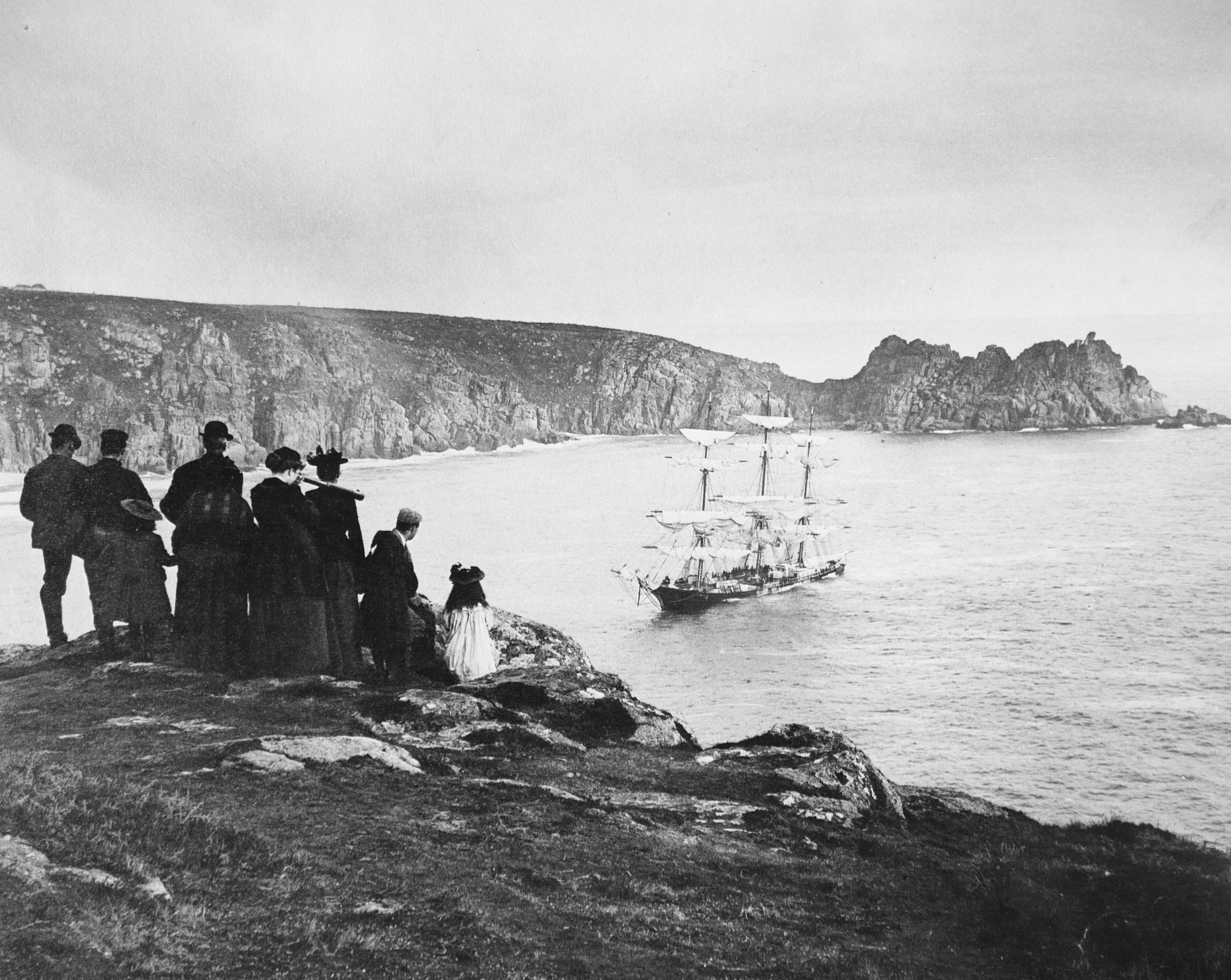
The Gibsons of Scilly (Scilly Isles, England, UK) watching a shipwreck, Granite State, 1895. A good representation of how scientists, onboard the sinking ship (Earth), analyse "Climate Change" and "Global Warming". Architects, feeling safe, witness the scene and seem to enjoy -so far- theoretical discussions, ignoring that the ship is our only home in the vast Ocean of the Universe.
Abstract
Find below the first lines of each chapter, or directly start reading the essay here.
2 - Mimic-Reality
The Earth has been affected by 10.000 years of constant deforestation and 200 years of intensive pollution. 19th century science developed into 20th century technique, producing a self-destroying scenario where architects (which for centuries created beautiful universes) are not leading in the environment anymore. We have been replaced by technocrats and bad engineers, who ignore the nature of things. For decades, theoretical discussions show a detachment from Habitat. Architects became fashion designers, often in giant urban proportions, building anti-sustainable contraptions in the name of sustainability. (...) Read this chapter, here.
3 - Habitat's Psyche
Meanwhile, architects became hypnotized with digital images, often ignoring tectonic and structural concepts, taking no notice of architectural principles, proportions, deprecating local materials (imperative to avoid transport pollution) and disregarding passive energy (an issue solved in the mid sixties). Absurd discussions organised in the Internet and for the Internet produce the illusion of a green attitude: the use of greenish pixels in clean digital renderings gives the impression of ecological preoccupation. It is not enough to have a scientific knowledge of materials and production processes, what is first needed is a wider understanding of our habitat in order to find a general path, wide enough to draw living spaces, energy, infrastructure and mobility into the same direction, and only then to use full resources and software to develop architecture. (...) Read this chapter, here.
4 - Broadcities
I propose small, autonomous, re-balanced and self-sufficient Broadcities, that will harvest crops and produce meat, exploiting and protecting sustainable forests, and will sustain small clean industries. These cities will create minimum energy using not only solar and wind power, but water and gravity. Oil will be used for trains, planes and inter-urban cars. Pollution by travelling and transport can be reduced to the minimum if we mostly use bikes and public transport. Industrial goods produced abroad will cross the world on wind powered trans-oceanic cargo boats: sailing ships will be back. On land, newly designed steam trains and light electric trains will be developed, and small lorries for inner-city transportation. (...) Read this chapter, here.
5 - Migrations
World population will be soon reaching 10 billion. Our ingenuous believe that the Earth had endless resources -and some capacity to compensate pollution- is destroying the environment and its biodiversity, breaking ecological and food chains. Genetically, our conscience and sense of time give us the impression that things happen slowly, we tend to survive rather than admitting the damage we produce, therefore we do not alter direction in time. The classical civilisation we built and enjoyed is ending into cyber extensions, mere parasite systems of our body and mind and as such, they started to affect our humanistic perception and reaction, of biological nature. (...) Read this chapter, here.
6 - New slavery
First, to abandon car-based urbanizations: walking, bikes and trains will save what's left of the landscape. Second, to avoid all plastic packaging and plastics in habitat, clothing, tools, toys and furniture, except in specialized instrumentality applied to scientific research and exploration. Third, to keep producing analog machines and techniques, they are recyclable and more ecological, they produce better products and employ more people: prints, images and sounds are full of harmonics, not mere sterilised flat pixels; pieces of real material art. Fourth, to get food from areas close to where we live. Fifth, refers to a factor that has transformed society in such a electrifying way, so violently that we are not conscious about how dramatically the life of most people has changed. I refer to the Internet in relation with mobile communication technology. I suggest to keep away as much as possible from what we know as social networks. (...) Read this chapter, here.
7 - Architectural Actions: Now
Unlike what everyone thinks, during the Cold War between the US and the URSS (1947-1991), the main danger was not global nuclear conflict, but our irresponsible actions against Earth's Habitat, following industrial pollution produced by consumerism. Even if the planet's climate is regulated by the Sun and its cycles of warm and hibernation (11, 70, 206 and 2.300 years, according to different scientists), the effects produced by contamination could be causing positive feedback events and in different segments of Habitat. (...) Read this chapter, here.
8 - Architectural Actions: Re-Balance
Our mission is to create innovative architectural projects that both anticipate and recover. Anticipate new forms of living... recover old ways of living. This apparent paradox, not easy to observe, is in the core of our Organic approach. There are ancient essential archetypes that link us with Nature, ways of understanding life that should not change: gathering around a fireplace, a dinner table, cooking our own meals. A small corner desk to write personal letters. A bookshelve, a library. Gathering with friens at home, getting closer, sharing a good conversation, looking at the sky at night, pointing our eyes towards the horizon in a long perspective "in the cold light of the morning", feeling the wind and garden flavours in spring, winter, summer and fall... Aphrodite's Child. (...) Read this chapter, here.
9 - Architectural Actions: Survival
To help our Earth to re-balance must be our objective. To stop oil, plastic and chemical pollution, a command. To plant billions of trees, our challenge. The planet will do the rest. It is interesting to observe that survival is more visible onboard a ship, that in any particular architecture. The Argentine aircraft carrier 25 de Mayo pictured below circa 1982 (former UK HMS Venerable R63, and Netherlands HNLMS Karel Doorman R81), seems to me the type of construction -in this case mobile and on water- that could be assimilated as architecture: literally, it is a floating piece of land, a platform with a tower on top and infrastructure underneath. I discussed this subject with Sir Peter Cook back in 1998, some afternoon at the Bartlett and, according to Peter, it is possible to define certain kind of ships (in this case, a major one), as pieces of architecture, particularly when they are seen from far. (...) Read this chapter, here.
10 - Architectural Actions: Energy
Habitat must navigate in three channels: first, each building will generate its own energy. It is imperative to acknowledge that "energy" is not only "electricity", but also, and primarily, the capacity of its structure (skin, walls, windows) to absorb, accumulate and release heat. By doing so, about 40% of all electricity produced in the world will be saved; second, current social energy needs -absurdly exaggerated- will be reduced; third, energy sources must be not only green but multiple. New low voltage artefacts should include different type of batteries or none at all, because the current ones are 100% non-recyclable, particuarly Lithium. Irons and microwaves cannot be allowed. Vapour and gravity can iron. Microwaves are a a great invention but usless. (...) Read this chapter, here.
11 - Architectural Actions: 1 to 10 Billion in 200 years?
It is imperative to consider how to re-balance the environment, rather than "sustain" it. The verb sustain means to support, carry, stand, underpin which in certain way defines an incomplete or temporary situation. On the contrary, not us, but the Earth will repair and rebalance itself to achieve a new ecological equilibrium. Unfortunately we are already witnessing the dramatic extinction of a large number of species. Our species (us) can adapt but cannot anticipate a global scenario beyond a few years. Unfriendly decisions will be required (if you are a car lover, for instance) which, if applied, can gradually diminish pollution. The pre-human "natural" scenario is long finished, but that is not a problem, because we are part of Nature. However, we are adapting, year after year, to a new Habitat that changed because of us. (...) Read this chapter, here.
12 - Architectural Actions: Bikes
Most of the data collected to justify what has been defined as Climate Change (later named Global Warming) was originated in a minor research centre, the East Anglia University, that received funds to do so at the times of Margaret Thatcher -Baroness Thatcher of Kesteven-. She was also a scientists by her own right. Alarming information started to circulate was soon taken by Washington and the UN, and finally by research centres in the US. After reviewing several available documents, I can state that this happened both because of a genuine research interest but also because of commercial convenience: oil and its industries became expensive. (...) Continue reading this chapter, here.
13 - Architectural Actions: Whose Side Are You On?
Architects will have to lead private movements to re-invent our civilisation (Latin "civitas" = city) but in a new balanced habitat. Initially because of rain and severe storms, rather than sea level rise, we will have to relocate coastal and river cities and towns in safer and higher lands; if those are at a sea level and people have marine traditions, the logical approach would be to create floating cities or parts of them able to float, rather than forcing millions to migrate. Because of unstable and extremely high temperatures in summer, some regions will have to adopt extreme measures. This is already happening since 2010 in Europe, in capitals like Paris or London, not used to heat waves: in the last summers they had more than thirty thousand deaths within a week, mostly elderly people. The same is observed in countries where hot summers are considered normal. The lack of statistics does not help. It will be not possible to modify reality at once. (...) Read this chapter, here.
14 - Bibliography
Read Pouchulu's recommendation, here.
15 - Online Resources
Find an essential list of resources here.
16 - Pouchulu's educational programme
Explore publications and Survival Architecture Programme, here.
17 - Statement: Adapting to Habitat Change
The following are six essential commands to stop destroying our planet (...) Read more, here.
1 - 2 - 3 - 4- 5 - 6 - 7 - 8 - 9 - 10 - 11 - 12 - 13 - 14 - 15 - 16 - 17
Contact Pouchulu here, or send an email to: architect@pouchulu.com More information in Deutsch, English, Español and Français, here.
Background photo: planet Mars, dust storm, PIA15959, Mars Reconnaissance Orbiter (MRO), courtesy of NASA
up