Index 1 - 2 - 3 - 4- 5 - 6 - 7 - 8 - 9 - 10 - 11 - 12 - 13 - 14 - 15 - 16 - 17 -
12 - Architectural Actions: Bicycle Revolution
Most of the data collected to justify what has been defined as Climate Change (later named Global Warming) was originated in a minor research centre, the East Anglia University, that received funds to do so at the times of Margaret Thatcher -Baroness Thatcher of Kesteven-. She was also a scientists by her own right. Alarming information started to circulate was soon taken by Washington and the UN, and finally by research centres in the US. After reviewing several available documents, I can state that this happened both because of a genuine research interest but also because of commercial convenience: oil and its industries became expensive, and the raw material is extracted in non-reliable or unstable countries. Global corporations intended to anticipate new technologies, not so expensive, but less efficient and, aparently, less pollutant. That is understandable. However, compared with solar or wind power, oil is very efficient. This is, apparently, a dramatic paradox.
The message was clear: carbon dioxide is the cause of Global Warming, "we must stop using oil" or we will destroy our planet. This is a fallacy, and I will explain why. Electric powered engines equally contaminate, not were they are, but were the electricity they consume is generated, this is, in oil powered generating stations, which still is the majority of its source. In fact, electric engines produce more pollution compared with oil engines, the latter are three or four times more efficient in terms of horse power. Not to mention that electric cars store electricity in batteries, that are far more contaminant for the environement, disposed off on the ground, in the air and water. The solution, eventually, is not only changing the source of energy, but to analyse how to optimise our energy requierements. We waste the majority of the electricity we consume, mostly lost in high voltage transmitting lines. At home we do not need more than 9 or 12 Volts and that power could be produced in each house.
When reading evidence from centuries ago we observe that climate has been oscilating on some sort of regular basis. For instance, according to solar cycle researchers (it is curious that there are not many, considering the sun is the source of the Earth's surface heat, and they have no major presence in media), according to them we are entering into what is known as 'mini Ice Age' by 2020-2030. The warming acceleration curve would slowly tend to revert at some point. If this event is not visible, it would mean that either the cycle is imperfect or the "mini Ice Age" model failed: it is not possible to prove we are warming the planet, because it is not possible to meassure "average" temperatures that are changing in real time from millisecond to millisecond in such a large organism. We only manufcture testing software that produce useful but imprecise models. It seems we treat the Earth as a Human Body, where indeed it is possible to test its (average) temperature.
The scenarios presented by experts from NOOA (National Oceanic and Atmospheric Administration, U.S. Department of Commerce), NASA ( National Aeronautics and Space Administration Administration), Max Planck Institute, JMA (Japan Meteorogical Agency) and others, are theories, manufactured projections. We can hardly forecast if it will rain or not tomorrow. The worst scenario has been defined as Abrupt Climate Change, which means that what should be happening in thousand of years might happen in a few decades or years. But that was only expressed in simple experimental models... and exploited by Hollywood catastrophe genre films around 2000.
What is the relation of this panorama with the use of bikes? If in the early twenty century we started to replace bikes and trains for cars. In the 19th Century, mobility and transportation in cities had been designed based on public transport, pollution was significantly less. One billion cars running every day are deteriorating our fresh air. Cars are an inevitable great invention, boosting our legs and arms, giving us a sense of powerfulness, but have also destroyed urban and country landscapes and killed 40 million people in 130 years, as we mentioned many times. Wherever a highway or route is built, ground suffocation (soil cannot breath and "dies" under asphalt or cement), instant contamination, violent occupation of the land and subsequent forest destruction of the surroundings comes immediately. I bring here an interesting example: Disneyland.
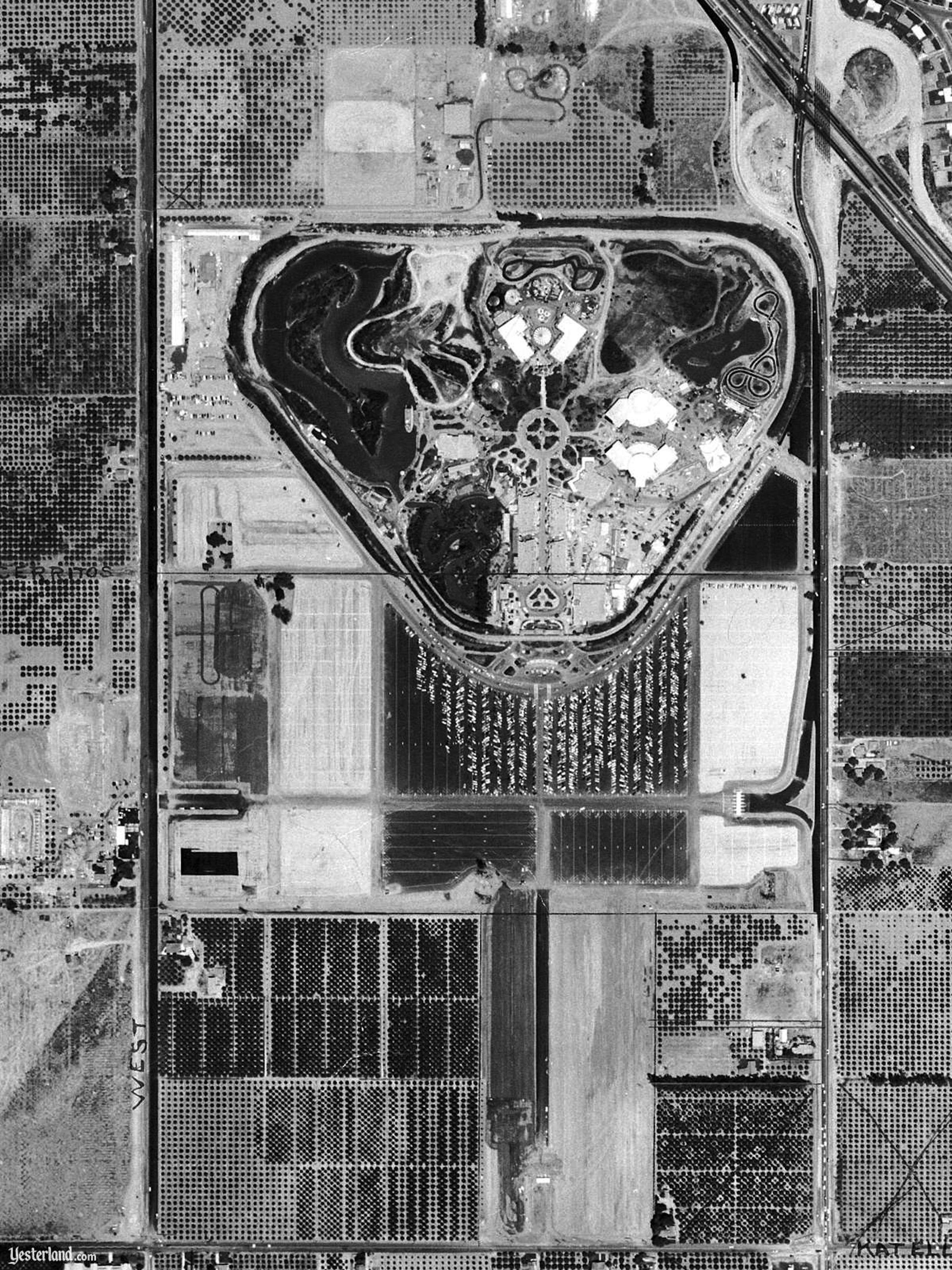
Disneyland under construction, 1955, aerial photo: photographer unknown, courtesy of www.yesterland.com
The aerial photo above from June 1955 is a peculiar example of how we thought and developed in the 20th and 21st centuries a concept for an ideal urbanisation or futurist city 'model'; it is the original and wonderful -why not- Disneyland, under construction. An area of 160-acre or 65 ha (about 8 square kilometres) was bought by Walt Disney, who personally supervised the design. Disney was a nice chap, my dad Pedro Pouchulu (pioneer filmaker in the News Reels industry in the Southern Hemisphere) meet him several times, the first one in 1941. Disney was an incredible visionary and businessman. This large piece of land used to have a variety of crops and fruit trees; an old small forest was chopped down and lead to urbanisation and zoning as follows: 15% for the actual performing space itself, directly offered to the visitors (amusement park with all the attractions, where guests spend the day), 15% for backstage services (training, maintenance, repairs, storage, seasonal depots, emergency technicians), 25% for car parking, 5% for the access highway and internal streets, 30% for surrounding gardens and about 10% for backstage cargo streets.
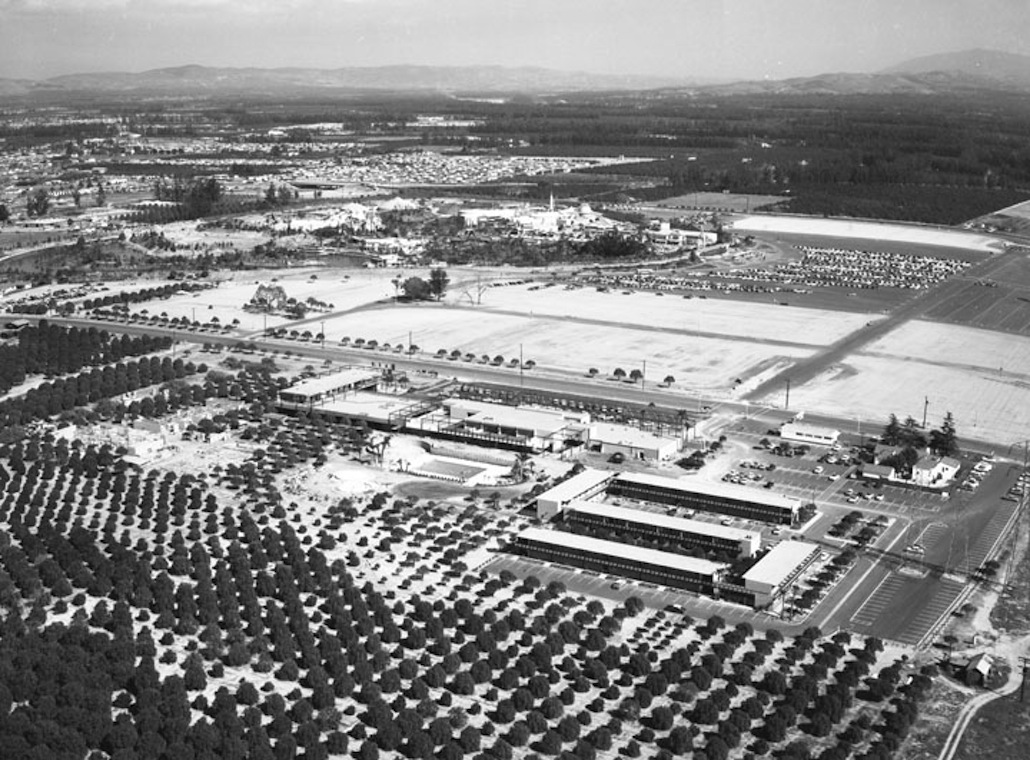
Disneyland under construction, 1956, aerial photo from South-West, Hotel at the foreground. Kelly, Howard D. courtesy of Los Angeles Public Library.
Out of the total, about 40% is a car urbanisation. This is the same proportion than in any town or city in the Americas. The original Disneyland Hotel, a five two-story guest room complexes, opened on 1955. Over the years, the hotel grew in size. In 1999 the original structures, seen here, were demolished during the creation of new resort parking areas and Downtown Disney. Above, the aerial view shows Disneyland. At this time, a few of the amusement park's now famous attractions existed. The Disneyland Hotel (foreground) is surrounded by citrus groves. The experimental and nice futurist Monorail from 1959 that for years, in updated versions, has been circulating all over the park, was a fine piece of engineering. It is a pity that they did not build a "real" one to bring people from the city of Orlando: instead, a huge wave of cars and buses arrive every single day -Interstate 5 passes directly behind Disneyland- from US visitors all over the world, since its opening till today. We have to be fair: back in the fifties, Walt Disney and his team were not more aware of habitat and ecology than any contemporary architect or scientist. In fact, Disneyland has only one problem: cars. For the rest, it helped to disperse people from big cities (again, they arrive by cars rather than trains), the proportion and integration of buildings on the land is satisfactory; once there pedestrians feel they can walk freely and quietly, the urban site plan is a bit organic and even interesting, and visitors, almost without exception, feel a good balance between small and larger entertainment areas, shows, services, surrounded by gardens and flowers. Disnelyland, arriving by train, could become a good model for a new city.
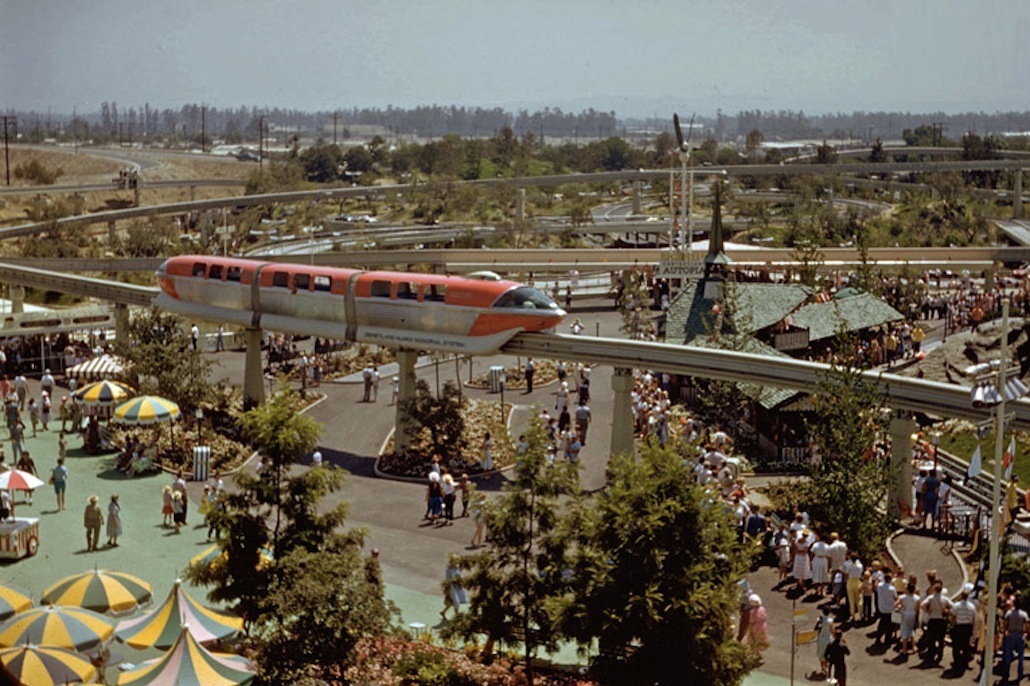
Disneyland, Tomorrowland in 1959, the Mark I Monorail. Photo: Fred M. Nelson, Sr., 1959, courtesy of www.yesterland.com
The combination of pedestrian areas and small light vehicles with aerial trains is interesting because it frees the ground, even if in this case most of the soil has been suffocated with cement -we can imagine a more friendly system that allows soil breathing, at least in part- but when we see the picture below, close to one of the parking lots, it is clear that the king of Disneyland was not Micky Mouse or Donald Duck, but the car. About 30 million visitors reach the resort every year, from which almost 94% arrive in cars.
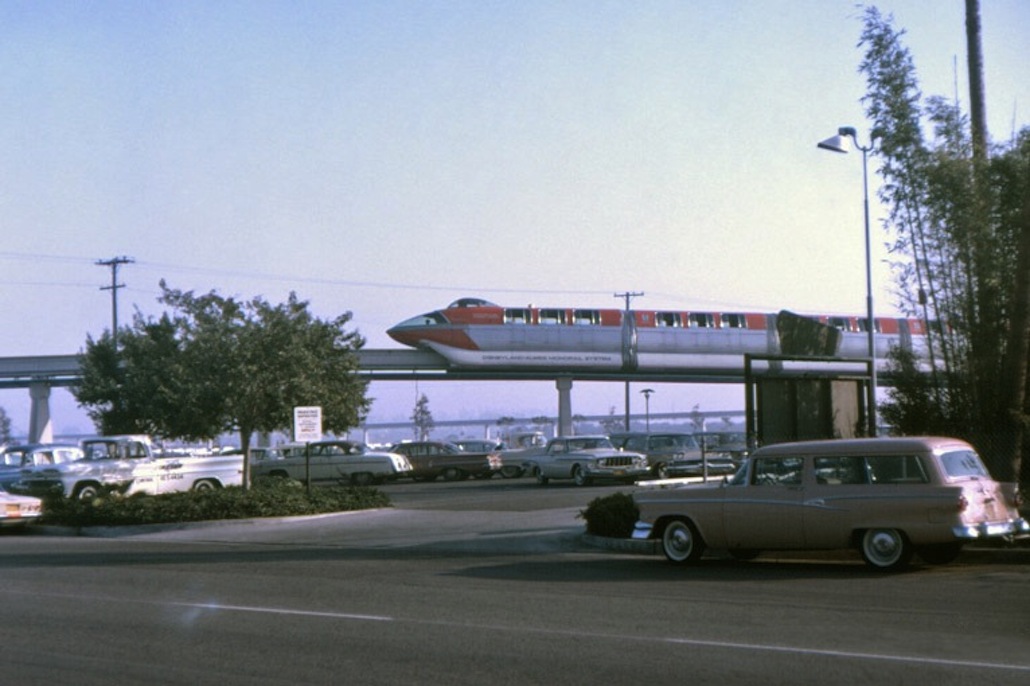
Disneyland, 1961, Monorail on the parking area. Photo: Charles R. Lympany, c.1961, courtesy of Chris Taylor and www.yesterland.com
In the context of Habitat Change our industrial civilisation must address three main issues: energy, transport and housing, and in that order. We cannot transform -at once- 200 years of fossil-fuel infrastructure and machinery, because the whole world is run by oil: planes, ships, locomoties, the military, power generation and more. But what we first should do is to be rational in the amount of energy we use in everyday's life. By de-concentrating large cities, creating smaller suburban towns, which could be powered by solar, wind and gravity power; inefficient, bulky, disruptive and polluting mobility systems (cars, buses, planes) must be replaced by efficient, light mobility mono-vehicles. A new generation of extremely sophisticated sailing ships will be back. Regarding energy, our Organicist Habitat Commands follows three energy generating principles: decentralisation, miniaturisation and polarisation.
Decentralisation: in the close future each house and each building will have to produce its own energy, low voltage like any ship or vehicle. No more mad high voltage lines crossing whole regions and countries loosing up to 55% of generated power in transmission lines, 10% in lifting power stations, and another 10% in each devices transformer that loses large amounts of energy as heat.
Miniaturisation: small devices are cheaper, easy to produce, fix and clean, very practical to monitor, replace, recycle and transport. What is the purpose of manufacturing and transporting prefabricated walls that weight a few tons each, that require large and expensive cranes to be mounted? The future should be smart and light. Except masterpieces and historical buildings prior to 1900, existing modern buildings should be reused, till the point it is cheaper to build new ones. Then we will create light modular constructions. Unless self-powered and fully ecological materials are proved, new towers must be banned and old ones demolished, one by one: lifts, water distribution and air conditioning are absolutely anti-ecological, not to mention the antisocial psychological effect produced by isolated 'social' housing towers. Miniaturisation also affects artefacts and objects in general. Here, the modern movement (mostly Bauhaus) pointed into the right direction.
Polarisation: from Physics, "restrict the vibrations of (a transverse wave, esp. light) wholly or partially to one direction". Construction and insulation materials can be pushed to their limit; for example, if we have air chambers in wall panels, we must design and set as many cavities as possible, in different layers, delaying the penetration of heat waves, which has the same pattern as light waves. Architects, assisted by industrial designers, should explore new materials and combinations to improve insulation, thinking of hot and cold temperatures.
We have been recording summer temperatures over 50 degrees in different places, including the Middle East, India, California, Australia and Brazil... however, it is not only normal a few days of extreme hot days, it also happens every year in Southern Europe, Spain, Italy, Greece, Israel. What media and "science" batpized as "anomaly" or "above normal" is just ann hyperbolic, dramatic way of defining high normal temperatures. Years ago we did not have thousand of "apps" and Internet "apps" monitoring temperatures, not to mention that those are just models with severe differences regarding the real temperature in different spots. It is software, and very, very imprecise.
The "anomaly" observed and promoted in media since 2010 in the Arctic seemed to be a hoax: the Arctic ice cap recovers in winter. The Arctic ice sheet was apparently "disappearing" and it has now returned. The manipulation of our emotions is visible. The majority of climatologists are amateur data collectors, not real scientists. They are apprentices. Indeed, we are polluting the Earth -no doubt about it- but there is no prove that temperature is rising, there is no possible model to meassure global temperature in a remote way. Sattelites can give an overall data. Useful to predict a storm. Useless to analyse the state of Habitat. To meassure temperature means to plant a device... everywhere, millions of them, this will never be possible, and it is not necessary. Models are just temporary, fragile mathematical constructions that, when projeced and extrapolated, can give us any data. Models can be also manipulated. What we see now in apps are just models, mathematical models supporting software machines that are very imprecise. On the other hand, the athmosphere is such a complex environment with the addition of one incredible factor: it is dynamic, it changes from microsecond to microsecond. We associate temperature with surface registration, but there are 10 km of air above us. What happens in the surface is just one aspect of the whole system. It is very complex and it has not been fully understood.
Why the picture of bikes? That represent honest mobility. It is clear that, to reduce pollution, people will have to use bikes, also, light small green mono-vehicles with no batteries, and the greatest transport invention: trains. By using bikes we avoid the gym and the psychologist, not bad at all. In combination with trains, it becomes the mobility paradise: one train of six carriages can transport 2.000 passengers. One car, about 2 passengers. A locomotive generates 5000 hp. A car, 250 hp. Therefore, a locomotive is only 20 times more powerful than a car, but transport 1000 times more people! A train of 6 carriages equals 1.000 cars. The cost of train infrastructure, compared with routes and highways, is about 50 times more expensive. Society is trapped in the car industry. Every citizen spends about 10% of his or her lifetime income in cars and oil.
It could be about 1% with trains.
This means a locomotive is 100 times more efficient than a car. If we consider the pollution a car produces in urban areas, the calculation is rather simple. There are 2 billion people running every day in 1 billion cars, that could be replaced by 1.000.000 train formations, worldwide. This is about 5 times the existing number, or, putting differently, by quintuplicating the number of trains in the world, 90 % of urban car pollution will dissapear, providing we replace urban cars with bikes and small pedalling vehicles propelled by pneumatic air compressed passive energy.
For instance, unlike what people believe and already mentioned in this essay, steam locomotives fed by organic coal are greener than diesel ones: when we burn wood efficiently we do not add new carbon dioxide to the air, we re-release the one absorbed by those trees in their life, so if we cut one and plant more, we can burn wood. What we must stop doing is burning oil and coal that was buried in the deeps, releasing enormous extra amounts of carbon dioxide that is not supposed to be in the atmosphere. The power of a new generation locomotives and large power engines should be provided by solar power and wind, and of course those trains will be much lighter and slower. There is no hurry if we want to enjoy the landscape.
Go to the next chapter, here.
1 - 2 - 3 - 4- 5 - 6 - 7 - 8 - 9 - 10 - 11 - 12 - 13 - 14 - 15 - 16 - 17 -
Contact Pouchulu here. More information in Deutsch, English, Español and Français, here.
Background photo: Dutch Bike Infantry during WWII, courtesy Dutch Army archives.
up