
Index 1 - 2 - 3 - 4- 5 - 6 - 7 - 8 - 9 - 10 - 11 - 12 - 13 - 14 - 15 - 16 - 17 -- --
3 - Habitat's Psyche
Architects became hypnotised with digital images, often ignoring tectonic and structural concepts, taking no notice of architectural principles, proportions, deprecating local materials (imperative to avoid transport pollution) and disregarding passive energy (an issue solved in the mid sixties). Absurd discussions organised in the Internet and for the Internet produce the illusion of a green attitude: the use of greenish pixels in clean digital renderings gives the impression of ecological preoccupation. It is not enough to have a scientific knowledge of materials and production processes, what is needed first is a wider conceptualisation and understanding of our Habitat in order to find a general path, wide enough to draw living spaces, energy, infrastructure and mobility into the same direction, and only then to use full resources to develop architecture. The main task is not whether we can become more efficient, but to alert our community and governments that, following all available scientific literature, what I call Habitat Change, (not to be confused with the Climate Change theory), is leading our civilisation towards irreversible Habitat Loss.
In the last thirty years architects have been playing with inconsistent ideas, which is unacceptable if the intention is to transform images into real material spaces. The fascination with sparkling virtual representation reached a point where built forms try to impersonate digital images. The other way round: our hand-made drawings tried to impersonate the final construction, therefore, the builder -under our direction- transformed our intentions into reality. In the last decades, when built, notable constructions are even awarded by critics that rarely visited the real thing. With a few exceptions, those buildings were built on fossil fuel energy and processed materials. This is like receiving a price for best performance as leading actor when the theatre is burning in flames.
For centuries, hand-made drawings showed intentions and the spirit of an idea (not a final object), hence built architecture was richer: architects modified, improved and finished the work through builders' craftsmanship. Architecture and cities were part of Nature, because they referred to the Universe with respect: in a way, they were submissive. Architectural spaces had traces of geometry, mathematics, history and poetry, which helped to understand our position in reality and life. Understanding that relation can help defining the Habitat's Psyche. Indeed, Habitat has spirit and mind; the former is represented in the sense of equilibrium and harmony, self-balanced, which evolves through time in a smoth way. This can be approach through the laws of hard sciences: geometry, mathematics, physics, chemistry, and Earth sciences: astronomy, biology, geology, oceanography and climatology, unveiled and perfected in the last hundred years.
However, none of these two groups of science disciplines makes sense if we ignore how to reason. For that purpose we developed logics, most notably formal logic. There is only one possible way to identify, analyse and understand the Earth's Psyche: by relating the available scientific knowledge through reasoning and, on top of that, to frame it with moral principles: we must understand that our Earth is a living organism, alive and fragile. I doubt that those who are in power, governments, organisations, corporations or the financial market are aware of this and if they are, the established collective mind conducted by secondary systems (law, rules, regulations, norms, protocols) does not help, but the contrary: institutions and their particular behaviour tend to protect themselves to guarantee its survival (not our's) and therefore cannot evolve re-considering their principles.
To organise a new and clean industrial society should be taken as an international emergency task by relevant transnational private organizations (forget the United Nations) and indeed by educational programmes in general and indeed by architecture schools. Since day one, industry de-balanced Habitat not only because the grow of economies depends on creating new goods: the majority of items manufactured today are not essential. To be honest, in our kitchen we basically need a cooker, a table, a cutting board and a very good knife. To the eyes of most people, technology has facilitated everyday's life... but it became very expensive in the process. Cars, particularly for urban areas, should be as simple as a small bumper car. Below, my mono-car design for Sandbangeles, 1998.
Pouchulu's Sandangeles, 1998 (in between Sandbanks and Los Angeles), Sandba-Matic, mono car view, original pencil drawing.
We were not supposed to release those trillions of tonnes of buried oil and burn it outside, but we needed energy to built civilisation. We consume Earth's resources to create our habitat, destroying it, replacing a non-processed scenario with Man's environment. However, we do not consider resources like minerals as a living part of our planet and nevertheless they are, not less than the salt and iron in our own body. We destroy forests, cover the soil with asphalt and cement, we occupy almost all available land and kill one by one species at a rate of 150 to 200 per day: insects, reptiles, birds and mammals.
In order to consider the Earth's Psyche we need a large debate, ironically, that sort of discussion that used to be guided by the Pope or Monarch's favourite architect-urbanist (Michelangelo, Wren, Haussmann, Mansard), but the last humanist architects died in the second half of the twentieth century. Only Frank Lloyd Wright knew about this. He clearly said engineers knew nothing about the nature of things and he was right: our industrial civilization is the consequence of limited visions, almost entirely based on late 19th century positivism, who had not any idea about the perspective and consequence of technical statements and "solutions", and could not anticipate that electricity, cars and machinery (and still cannot) were going precipitate the extinction of species; an absurd obsession with obscene structures, ego-mobility (cars, highways), and the production of (basically) useless artifacts made of plastic (now in every household) was going to pollute land, sea and atmosphere. The last architects operated in the fist half of the 20th century. It is incredible that our community has not realised that a building -in any latitude- does not requires much electricity for heating or illumination: passive energy has been extensively studied and checked, it works beautifully. Many prototypes have been built, even schools, in the mid-60's. It was abandoned. People have been hypnotysed and fascinated with a futurist world run by "smart" devices and "applications". An excess of lightweight democratic practice in these emergency times, mixed with bad decisions and wrong priorities has paralysed what used to be the best aspect of our architectural community: to integrate great and magnificent ideas into Habitat.
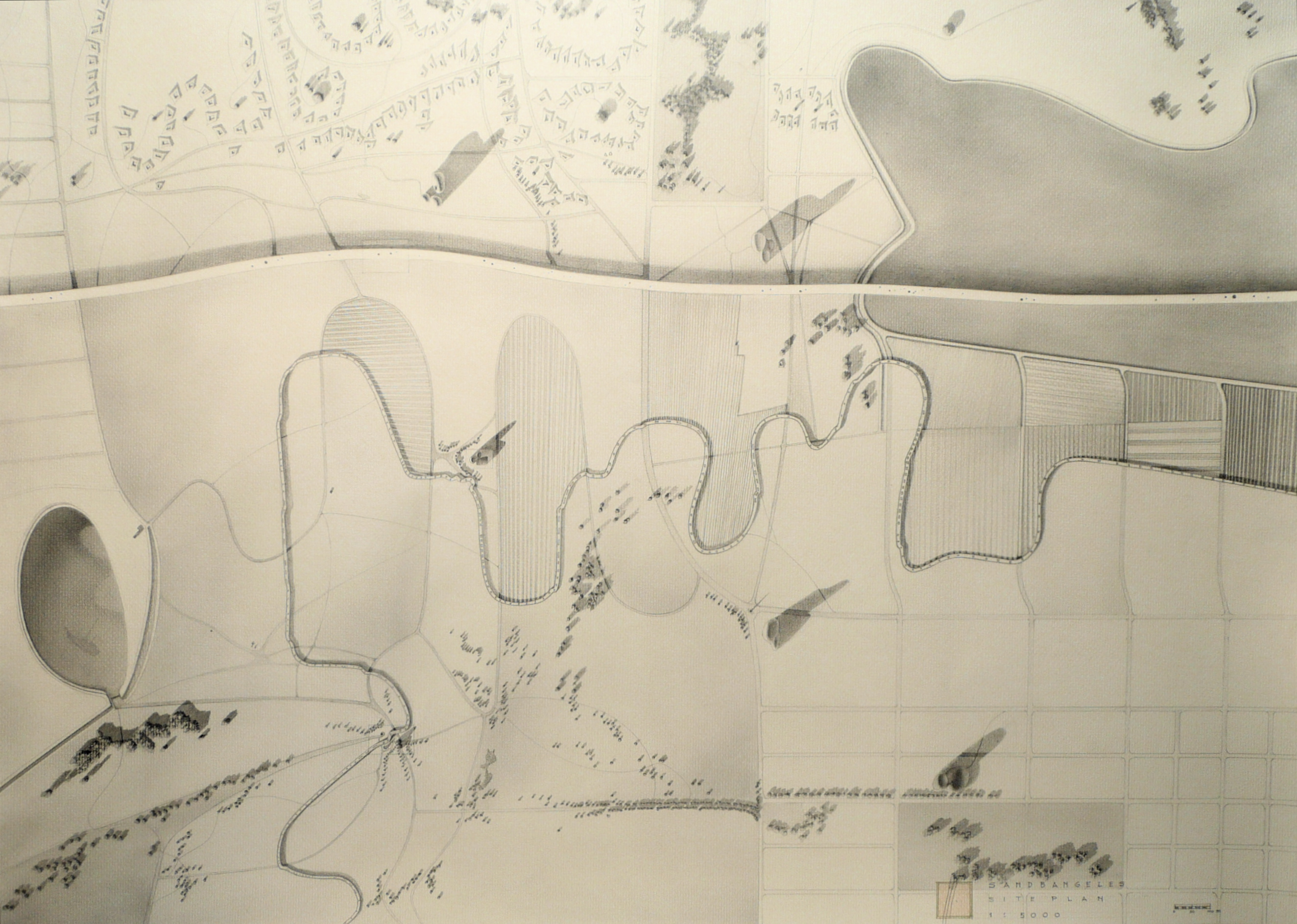
Pouchulu's Sandangeles, 1998 (in between Sandbanks and Los Angeles), aerial view of the newly urban settlement under extreme weather. At the top, the Highway Building, forests' strips (below it), random shelters (above it), the Endless House (continuous refuge), and different emerging areas of resilient trees. At the left, the water reservoir in a double-underground facilities. Black pencil on canson.
This fascinating but dramatic mechanised world anticipated by Fritz Lang in his masterpiece Metropolis, 1927, and projected in time by Ridley Scott in his Blade Runner, 1982 -full of industrial debris that even amazes us- reveals materials, technologies and manufacturing processes that work independently, producing an immense range of goods and services, but in relation with pollution and rubbish they are all harmful and operate detached from each other. These extensions have created a sort of Frankenstein monster type of Habitat, where the quality of life as a whole -and not only in big metropolis- is constantly diminishing: mad juxtaposition of high-rise housing blocks, huge smelly highways that destroy urban space, dead-end spaces that promote crime, large 'shopping centres' that kill town and villages' small shops, dysfunctional public areas, endless sign posts pointing nowhere, dangerous hanging cables everywhere, infrastructure (and policies) that favour aerodynamic polluting-machines (cars, drones), frightening immense airports, stations that remind of prisons, petrol stations and out of control advertising and unimaginable, inconceivable amounts of rubbish. We have produced anti-spaces where nobody would like to live in; the perfect environment for anti-culture expressions, like ghettos, gangs and the so called "urban tribes", extending the practice of disgusting body tattoos, masochism practiced publicised as a form or art, and graffiti, a form of public mass space masochism, promoting pain and humiliation before our eyes.
A self-pity reaction from society has accepted them as art: I think of Adolf Loos: indeed, the dead are always in the wrong. Pedestrian are violently pushed away, shops tend to disappear. In the US, more than in Europe, there are less and less public spaces where people can meet: there are exceptions indeed (I think of San Francisco), but in general life is organised around cars. This is happening since the early fifties in the US, origin and core of automobile and supermarket industries, and basically in every factory-country, like Russia, Germany, Brazil, China, India, but also in smaller countries like the UK or France. Only a few old cities are somehow successfully fighting against cars, like Amsterdam or Copenhagen. Between two and ten million cars enter every day many world capitals, polluting and generating a mobility misery, extreme noise, accidents and deaths. This can be solved with bikes and public transport, particularly trams and trains, but the final solution is to de-concentrate big cities, creating small urban centres that will require jobs in the suburbs, avoiding the daily commuting routine that pollutes and erodes workers' life, resting not only efficiency, but life quality. Cities' highways shoud be (all) reconverted into linear parks holding trains and trams. Mobility issues would be resolved within ten years, everywhere. Cars should be mainly used for inter-city mobility.
New expensive polluting materials and software-controlled devices are adopted in a wild market, where mere innovation does not allow a wider approach, disengaging our understanding of what architecture and urbanism should be, blocking a necessary perspective of things. In architecture, remote-activated fittings -so called "smart"- are anti-ecological, they are expensive to manufacture: in general, we just need levers. Le Corbusier was wrong: architecture is not a machine. 20th century technology has been extremely industrious and from an academic point of view, even funny and highly stimulating -I think of beautiful Archigram- but thanks to 21st century's digital visualisation it has entered a territory where hyperrealistic renderings and sophisticated software and hardware manufacturing extensions allow excessively complex mechanisms, facilitating the development of extreme complicated ideas, which are expensive and anti-ecological. In the pre-digital era, when we had to draw by hand, we avoided unnecessary complications and naturally tried to make things logical, economical and simple.
Highly technological materials are usually harmful, because their production process contaminates with lithium and large levels of carbon dioxide. Logically, part of what we create as a society has to do with our biological and psychological will to survive in the short term. That is what we all do, and what society also does. The first necessary path is to focus explicitly on educating children and young people on this subject, but unfortunately a large group of outsider thinkers is needed, and everyone seems comfortable talking and learning about finances, technologies, weather, sports, irrelevant news all time favoured by the non-expensive totalitarian digital communication. Every now and then we must stop and think to correct and re-direct our perspective, and this has to happen before deciding how to do things. In the digital era we are becoming experts of solving irrelevant technical problems created by wrong diagnosis. Someone says "we need faster cars" and people will buy faster cars, and it is immediately transported into the construction belt. Someone says "electric cars do not pollute" and we all buy electric cars, when actually they pollute more: where the electricity they use is produced. We ignore that the core of our Time is not our capacity to solve obstacles, but our right priorities. We handle atomic power, we went to the Moon, we are exploring the Solar System, we are unveiling genetic engineering, but we cannot see in perspective the physical and psychological consequences of Earth's habitat modification. We cannot prioritise anymore, because our collective mind is blind in relation with our consumerist habit and banal tendencies induced by digital advertising. Our environment and surroundings are detached from the functioning of Earth life's systems, even if they are part of it, they are not more legitimate than those of insect communities. The 20th and 21st century Man is a poet indeed, but a poet of destruction; a simple predator.
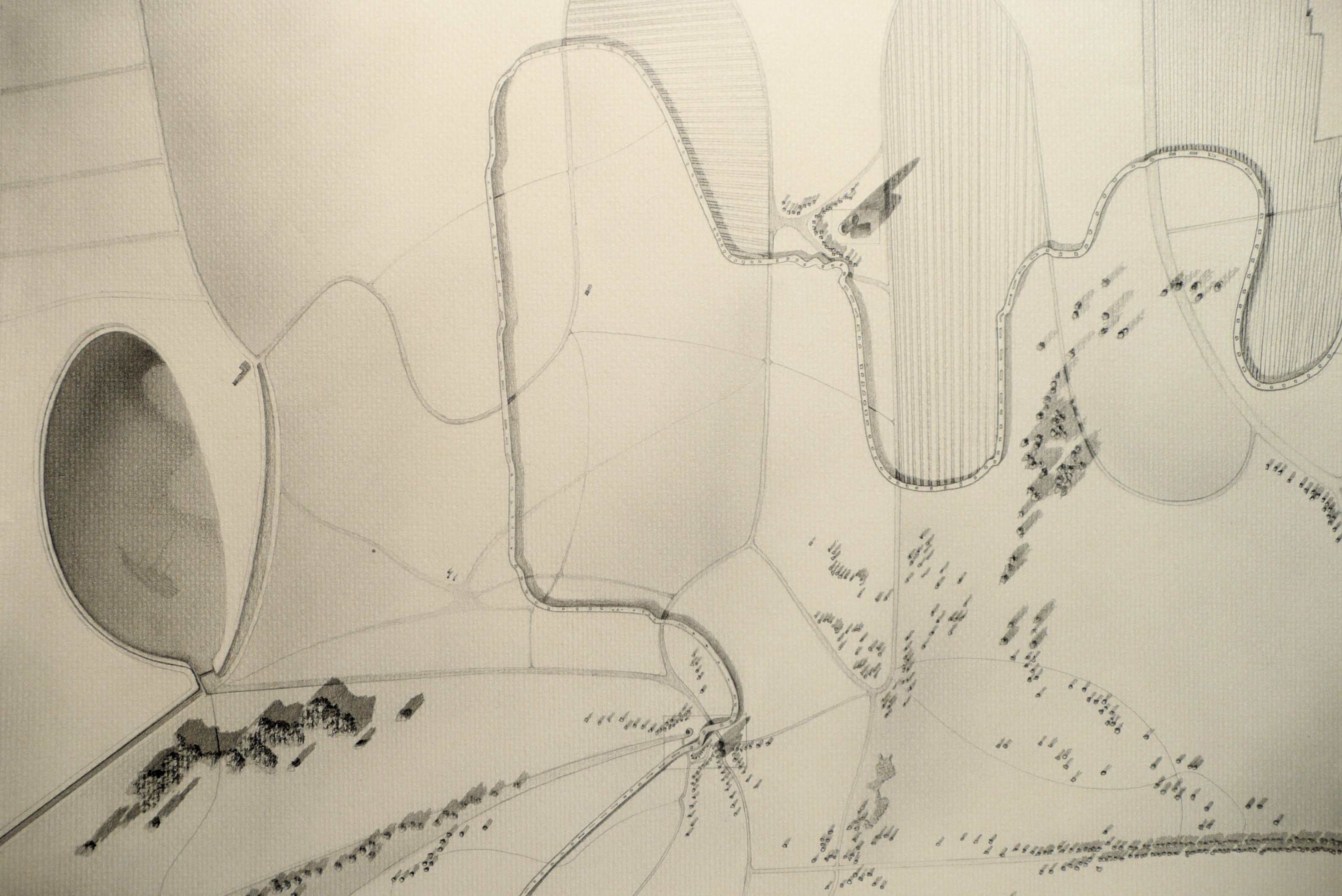
Pouchulu's Sandangeles, 1998 (in between Sandbanks and Los Angeles), idem, detail of The "Endless Building". Black pencil on canson.
In order to understand this reality we must change our way of thinking. Regarding Habitat Change we cannot expect much from the government, banks or corporations. An officer has neither training nor interest for understanding the nature of problems; in fact, they form a particular and defined way of collective thinking within the secondary systems, following pre-written paths, and as such they cannot change or improvise, unless the mandate comes from the top, which means someone in charge with common sense and vision will shock the system below him, which is rare. In general, when someone has a vision lacks power and the other way round. On the other hand, how can we change the mind of millions of people when they have been hypnotised by marketing? A few people are leaders, the majority are followers.
Different organisations and individuals in different latitudes are alerting society about the need of changing, yet they get organised by using the Internet, without realising this media is self-controlled by its own anonymous collective thinking, now ruled by AI, which is not intelligence but very fast software. In fact, Internet's governance looks anonymous but it has been designed by electronic engineers, marketeers and programme managers instructed by large financial groups, whose main goal is to offer a global service of world's population surveillance, for profit. The plan is working beautifully: everything we do with Internet is monitored and archived, associated with our name: they have filed us; which stands very far from any ideal purpose of educating people in the art of reasoning and thinking. Humans are the only species able to anticipate events. In that sense, we do better than any other animal or biological species. But we seem to be loosing something very important: will. Like any superior primate, we tend to copy and follow others. What are most people doing since they wake up till they go to bed? checking emails, instant messages, so called "social networks" and news in their mobiles. So whatever is uploaded there changes the perception of our surroundings and understanding of reality, every day, every hour, every minute. There are a handful of trully originating sources. They are immediately copied and forwarded a thousand times per second. Any news, any sentence, any propaganda works like never before. It became impossible to discern real data from false one.
Forty years ago global corporations installed a big statement: Global Warming produced by industrial civilisation is putting an end to life on Earth. One way or another, many people believed that. Scientists and researchers are also ordinary people, badly affected by both open and subliminal brainwashing. However, no one pointed that Global Warming is not only just an hyphotesis, but the way it is presented hides the main problem: pollution. Most transitional industries promoting and financing electric cars, wind and solar power in the last 15 to 20 years ended up with wrong solutions because these cars are less efficient and more polluting. The use of batteries (which are non-recyclable and highly contaminants, particularly Lythium) is a very bad decision. The extraction of raw materials, particularly rare earths, and in particular the manufacture of batteries is the highest polluting process known. Just to remember: every single device is powered by Lithum batteries these days.
This is clearly seen in absurd debates -often on important issues- where there are always two groups of people arguing. This sort of "reality show" imposed as entertainment has push society back hundred years, if not more. Very rarely we reason and notice that solutions are combinations of many points of view; sometimes changing our position regarding one particular issue, will help us seeing problems from a new and -hopefully- better angle.
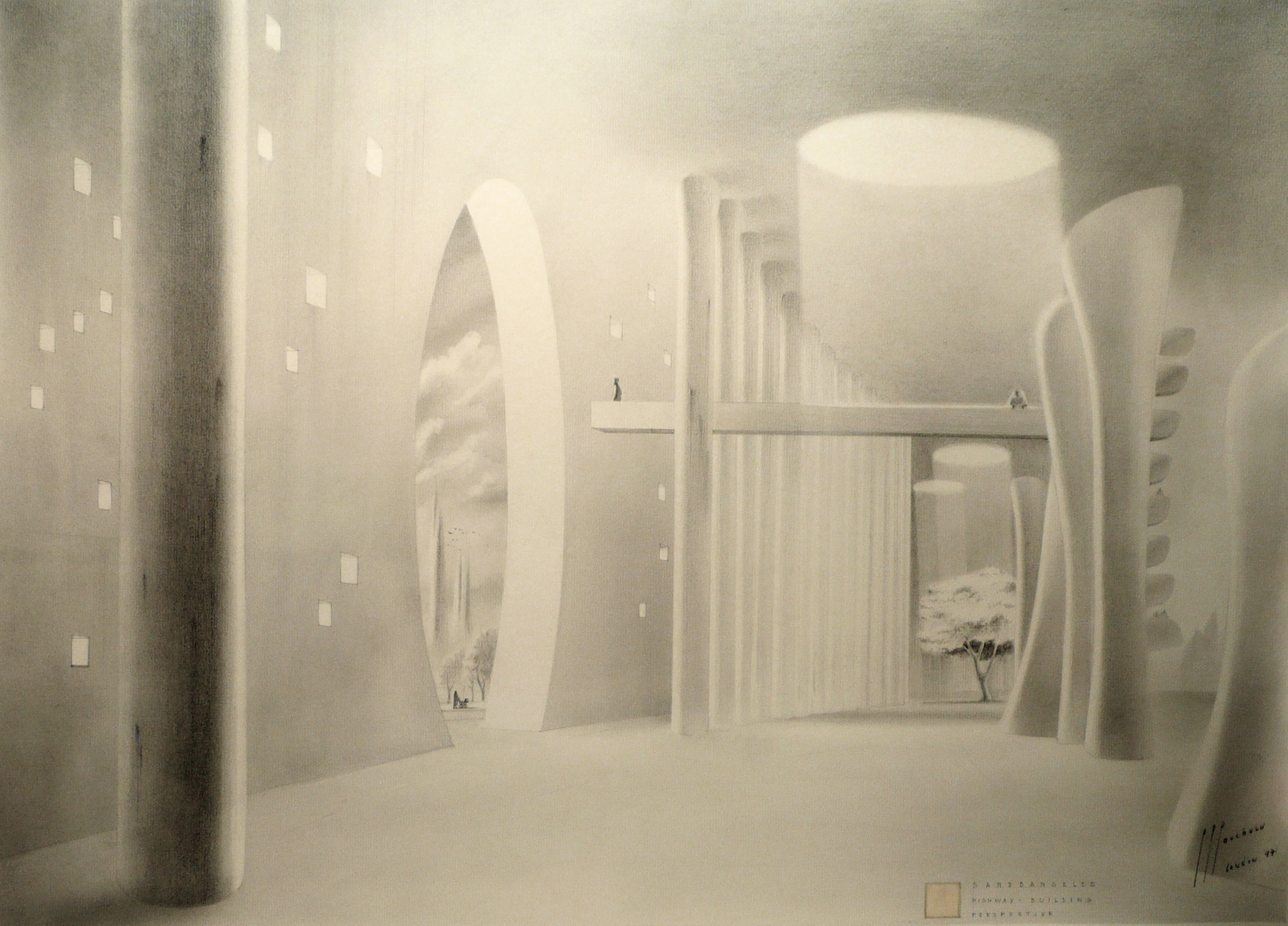
Pouchulu's Sandangeles, 1998 (in between Sandbanks and Los Angeles), The "Highway Building". Within a hostile hot environment, this public-private space is regulated by passive energy. No electricity is requiered, only in very selected spots and mostly for communication and educational purposes. Black pencil on canson.
Earth's Habitat has a fragile Psyche. Information and statistics are crucial to anticipate scenarios, but we need more than that, we require verified knowledge; in that sense, the first step is to recognise that what we know about Habitat is neither definite nor final, but temporary. However, informing about facts is always dogmatic, it is often a fraction of reality. Half of the world's forests are gone; the Oceans are dying, one third of sea's Phytoplankton has vanished. Facts. We also have to accept our species not just as the dominant one, but as a very particular that is precipitating extinction of all the others and started to severely alter the whole Habitat chain: Earth's geography has been affected mostly by massive deforestation, catalysing erosion by rainfalls in (now) exposed soils, ruining farm fields, provoking changes in local rain parameters, and therefore creating micro positive feedbacks. We should consider our precious Earth as a biological organism, much, much more complex than any existing plant or animal. Earth has not only been sustaining us: it is alive, its core is made of melted iron: this is energy, gravity and complex cyclic movements, which are linked with the Sun and planets. Actually, our planet is the most complex organism we know, made of systems and subsystems in a sort of inverted Mandelbrot fractal structures, those the late Arthur C. Clarke was fascinated about.
These structural systems start at the red hot core, magma, crest and surface, where basic organisms cohabit, vegetal and animal species and sub-species, within a complex biological environment, basically scattered within water, air and soil, protected by atmospheric layers, Troposphere, Stratosphere, and so on. Regarding Habitat, there is no mathematical model to predict what will happen in hundred years, ten, not even in one year from now. What we have produced are tentative projections, for instance, mean temperature average data with a series of algorithms in selected Earth's spots; changes have been deduced in specific climate patterns (El Niño, La Niña), ocean acidification, sea currents and level variations (deep currents warming and slowing down), Arctic and Antarctic estimative ice loss, scattered but well managed data showing the seas' oxygen level lowering, and atmosphere disruption (excess of toxic metals and gases); all this is happening fast. It is not possible to assess Habitat Change without learning biological sciences principles, also while revisiting history of architecture, land use, and applied technologies. Habitat has clearly been changing because of us. Habitat is changing, however, if climate is changing for the first time because of us, it will never be possible to assess a final scientific conclusion (an experiment must be observed and analysed many times before reaching any conclusion leading to the discovery of a scientific law). Moreover, we do not have any choice: we must understand the Earth's "Psyche". It is the next generation's challenge, even if it seems too late, it is not. What has definitely changed because of us is our Habitat, that includes climate but also Ocean and land. Architecture schools should start teaching philosophy, biology and Habitat at once, reducing the time dedicated to pure theory and language speculation, often irrelevant if not ridiculous.
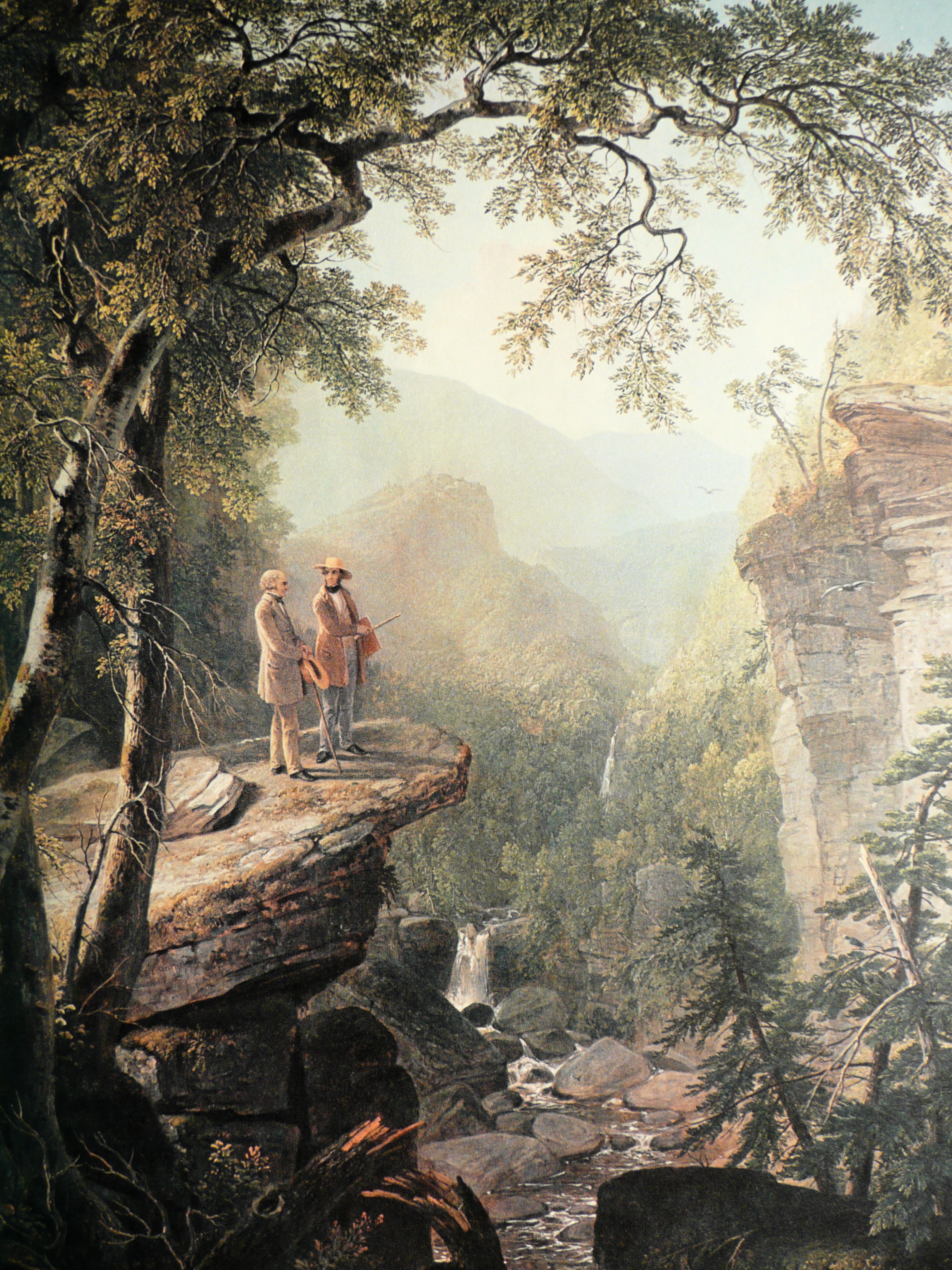
Kindred Spirits, by A. B. Durand , c1849. This wonderful painting shows how different was our approach to nature in the mid 19th century. We admired it, we took time to study, explore, think. Perhaps in each epoch there is no particular type of Man, perhaps there is no such things as collective mind, and what happened with our Habitat is that those less sensitive people only interested in trade, commerce and luxury prevailed over those moderate spirits like writers, painters or architects.
How should we analyse and understand Earth's Habitat? First, we must consider the sense of unity. Any living organism, the more complex is, the more sensitive to minor changes becomes. That is precisely the opposite to what common sense dictates: a paramecium (a single-celled freshwater animal) is not badly affected by large temperature variations; a tiny insect, more complex, can resist 200 degrees; trees, more complex than many insects, not more than 50 degrees; but mammals and humans can only face an average range of 20 degrees in their particular environment (humans cannot live under 15 or over 37 degrees without extensions or clothing). In fact, under a exposure under 37 degrees and 100% relative humidity, we die after three or four hours because of organ failure. I do not trust data promoted as "average temperatures", as mentioned before, because it is not possible to calculate it. Sattelite devices are imprecise, just sensor devices collecting information from far, processed with software. Temperature measurement started to be systematically recorded 200 years ago, and just in a few cities. However, climate, like plants and animals, have left traces in fossils; there are proved scientific evidence about temperature variations in the past including data not only from thousands, but millions of years ago.
What can we do? To study, to understand the Earth's cycles; if you are an architect, try to acknowledge our role as experts in the environment, to become communicators, alerting about Habitat loss and anticipating sensible architectures where the rule will be an extensive use of passive energy, minimum electricity and an absolute elimination of consumerism. Pretending to replace fossil fuel (oil and gas) with electric devices it makes no sense, because batteries are as pollutant or even more. Solutions should not be based on technology, for the simple reason that technology is a vector, not the solution. This vector can point to different directions. So far, corporations point where they want us to go, in order to sell us whatever they can -including mobile phones and virtual products-. Architects should understand that we need limited technology for buildilng spaces. Architecture is not a machine. Primarily, it is a shelter.
Solutions, if feasible, will be based on general thinking, trying to understand the nature of things. Most species' behaviours are interconnected; not just in food chains, but the role of mammals, fish, birds, insects in relation with plants and soil is very complex and must be acknowledge as a whole, both on land and oceans. Do you remember driving in your holidays to the countryside, and the whole front and the windshield of your car ended full of dead insects? Not anymore: according to a recent paper, compared with 1980 the world has apparently lost 70% of its insects; but I doubt the figure: it could be higher or lower. If true, this is a bad sign. Mother Nature, on the other hand, always surprises us. The wheel of life is not fully understood. Nevertheless, egocentric people still drive powerful cars where it is not needed, fuel or electric (the latter pollute the same but in a different place, where energy is produced, and batteries pollute more); get food from thousand of kilometres (ignoring that transportation pollutes badly), buy plastic toys, pack and wrap everything -even food- in plastic, get non-reusable goods, re-decorate homes and offices just because 'it looks old', with false wood, false stones and false marble made of contaminant plastics. Insustrial civilisation detached from nature, now we are paying the consequences. Time to stop and think; patience and shuffle the cards.
Go to the next chapter, here.
Index 1 - 2 - 3 - 4- 5 - 6 - 7 - 8 - 9 - 10 - 11 - 12 - 13 - 14 - 15 - 16 - 17 -- --
Contact Pouchulu here, or send an email to: architect@pouchulu.com More information in Deutsch, English, Español and Français, here.
Background photo: planet Mars, dust storm, PIA15959, Mars Reconnaissance Orbiter (MRO), courtesy of NASA
up